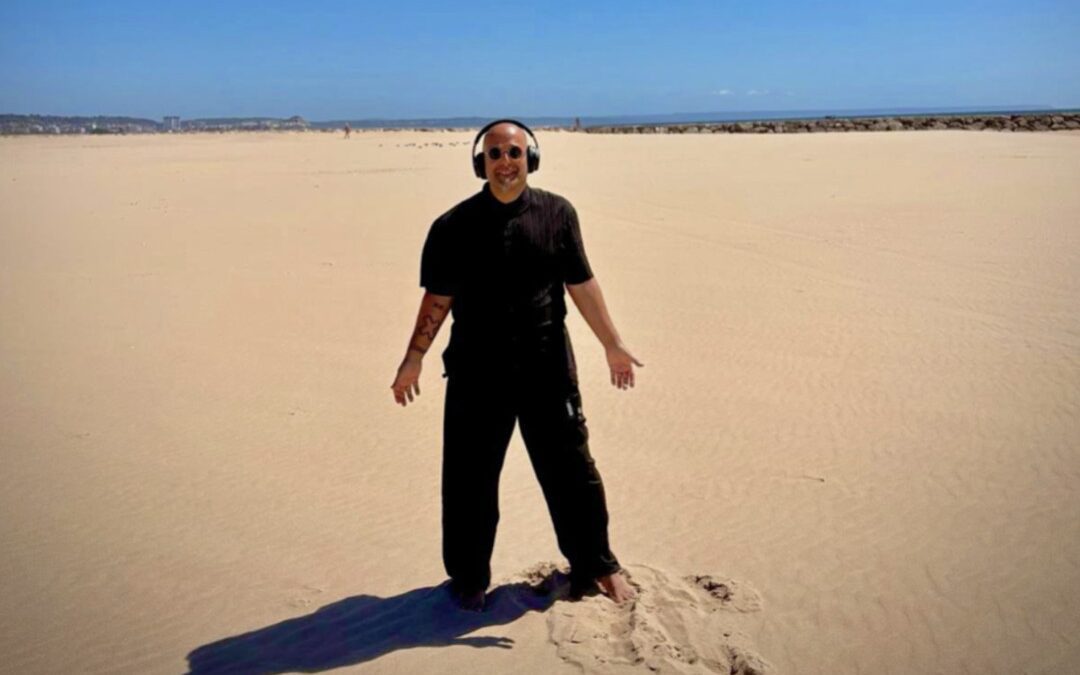
Photo credit: Vítor Belanciano
by João Øbo · Rågeleje, Denmark
João Øbo recounts his solitary journey through recurrent periods of unremitting torment and invasive noise in a world where even silence is loud.
·
For more than six years, I have lived with chronic health conditions in both ears. Invisible, yet all-consuming, they have redrawn the contours of my existence — altering how I speak, work, create, love and commune with others.
This is my modest endeavor to map some of my inner terrain of struggle, bewilderment, fatigue and solitude — and of those rare, delicate fleeting moments where relief and meaning may flicker into being.
·
The first signs manifested with no single sound event, no dramatic rupture. More likely, it was an asymptomatic, hidden, cumulative process unfolding over years, possibly triggered in a split second in late summer 2018.
One day, I took a fall in the United States, on a mountainside close to Lake George, NY, while doing some running training. After slipping on a patch of grass, my body flew into the air and I hit my head on the ground. I returned to Denmark three days later.
After that, somehow I felt slightly different. Life went on as usual, but something invisible felt heavy and was weighing inside me.
Exactly 10 months later, I woke up with pain and fullness in my ears and strange distortions in how the world sounded. An infernal chorus of ear noises had taken hold as well: ringing, hissing, bizarre metallic tones layered one upon another. They multiplied and grew harsher, never subsiding.
Sudden deafness set in, bilaterally as well, also worse on my left side. Doctors advised me to “wait and see” or told me it was “incurable” and “for life.” I hoped it would go away by itself. But as months slipped by, the symptoms deepened and the answers thinned. Thus began my quest to fathom what had broken — and how to endure within this altered, distorted new world.
·
In those first months, I pursued clarity with almost desperate resolve: consulting doctors, reading through research and listening online to fellow sufferers from around the world. Eventually I found the words that defined my conditions more precisely than the vague catch-all “tinnitus.” These words were hyperacusis, noxacusis and reactive tinnitus — in my case, multiple, aggressive and highly volatile. I was incredulous. I had never heard of such conditions before.
Early on, having felt slightly better for a few weeks, I attended a party in the Danish countryside. I irresponsibly took over disco-dishwashing with other partying peers (that is, dancing to disco while singing loudly and washing dishes). It was really fun and loud. But it was a major mistake. I worsened considerably.
In the following two years, during the pandemic, I kept worsening significantly due to extensive dental treatment prior to undergoing intracranial surgery to remove two huge arachnoid cysts tucked by my brain, and also after I was administered the Covid vaccine. Later on, I would worsen once again after some aluminum shelves and bottles abruptly collapsed on the floor in a supermarket.
·
Tinnitus is the ceaseless perception of phantom sounds. Hyperacusis is an extreme sensitivity to real sounds, where the faintest noise may cut like a blade. Together they forge a vicious partnership. Deep ear pain and oppressive loudness heighten my reactivity to the outside world, while external vibrations and high frequency tonalities feed back a storm of cruel pitches to possibly defective pain receptors within my ears.
For me to be able to finally name this devilish trinity was to glimpse some order in chaos. It offered a fragile measure of clarity, solace and even a few tears — for at last, I knew what to call these unknown afflictions, and begin to better understand my symptoms. Mainstream science, however, could offer very little beyond terminology. No known audiology test could capture the depth of my torment, no treatment marked a path ahead. The truth soon sank in: I was largely on my own.
·
Again and again, I found that no one in the Danish health system knew anything about my ailment.
From the beginning, I met genteel disbelief, helplessness or just pure dismissal. One encounter, in particular, still stings. Approximately one hour into a consultation for which I had waited a whole year, the only Danish “expert” in this field vehemently declared, “The brain is everything!”, abruptly reducing my suffering merely to behavior, psychology or ‘the power of will’ alone to “train away” symptoms, thusattempting to erase with stuffed speeches about ‘habituation’ and ‘sound therapy’ (which hurts me!) the physical realities I had painstakingly laid out in utmost detail to him, both in a three-page introductory letter that he never read, and during the consultation itself.
Such moments reveal how unprepared medicine can be for a patient who is not only deeply affected, but who is also knowledgeable, articulate and unwilling to accept platitudes from the medical establishment about his rare health condition.
I was left alone, once again, with my undeniable reality: vibrating, full, aching ears; physically painful and relentless sound crises; and a myriad of everyday noises no one else heard or perceived as hurtful.
My symptoms are not imaginary. They are clearly physical, fracturing my concentration, suddenly shattering conversations apart, turning even the briefest social contact into a painful trial.
Survival has come to depend only on my endless small daily strategies — always keeping my surrounding environment quiet and calm; protecting my ears outdoors; and avoiding the spirals of uninformed, conventional, standardized medical and layman opinions.
And so the years pass; the symptoms shift, mutate, tighten their grip.
·
Ironically, I suffered another sound shock by a sudden set of violently loud coughs and sneezes from a meditator seated right behind me at a meditation session on the 10th day of an otherwise absolutely silent meditation retreat in Sweden.
Since then, I have lived with a new tinnitus sound — a rough bass note — added to my overall tinnitus baseline, which is six tones in the left ear and three in the right. Each differs in pitch, texture and volume. At times it is as if they fuse into odd metallic roars before splintering apart. The loudest tones cut through everything. The quieter tones reveal themselves in silence.
Patterns shift, triggered by stress, voices and a wide array of environmental noise. Paradoxically, even a nap may turn a softly manageable day into a full-blown crisis. I wear ear protection in my sleep when around humans or pets, yet pain can unexpectedly erupt even in total silence.
Acoustic filters [ https://earos.com/pages/learn-more ] and earmuffs remain vital to my survival, helping avoid sound crises that can last hours, days, or weeks.
·
I seldom socialize in person now, and then only with one or two friends at a time, most often outdoors in nature. During the pandemic, when Copenhagen lay empty, I could walk freely without protection. That freedom has long since vanished.
Once I lived fully: stage artist, film editor, public speaker, animal activist, amateur athlete. Now I am unemployed, isolated and poor, surviving for years way below minimum means. Friendships have withered. I am lucky to enjoy my own company — reading, writing, art, and above all walking. I call them survival walks. Friends sometimes join, bringing stories and joy, though even their laughter may, at times, pierce me with pain. I have learned to live at ease in my aloneship.
Meanwhile I had to move to the countryside northwest of Copenhagen. It is quieter though lonelier. My ears have stabilized somewhat, though not improved.
·
I am unable to work. Unemployment officials don’t know what to do with me. A year ago, a new job consultant demanded I enter job training, citing a line in my doctor’s health report wrongly suggesting I could work using noise cancelling devices. It was dangerously untrue. This was one of the few times I lost my composure, shouting desperately down the phone, out of fear, in utter powerlessness, an outburst that itself triggered another prolonged ear crisis.
My doctor’s naïve mistake revealed, yet again, a stark lack of understanding of my condition. I wrote him at once urging correction, emphasizing that mine is a rare, constant, slowly degenerative, incapacitating and brittle state, for which Denmark lacks both expertise and proper protocols to manage. To his credit, he apologized, and a truer report was issued.
I am tired of defending myself, of eternally explaining what no one fully grasps. Even close friends, despite their kindness, repeat the same questions and noises, and forget the same details.
Until audiology abandons its prejudices and dogmas that often cause harm, patients like me will continue to fall through the cracks. Too many of us, in total desperation — as we know too well — end their lives.
·
Amid perpetual exhaustion, I have found one abiding resource that keeps me afloat: Vipassana’s secular form of meditation. This has become my counterbalance.
Meditation does not lessen my symptoms. They remain unpredictable, often flaring while I sit. Nevertheless, the practice, in a safe and silent environment with highly seasoned teachers, anchors me in reality as it is. It teaches me to face both mental and factual physical pain with neither recoil nor flinching, to endure it fiercely and courageously. This has brought me a sliver of relief — faint, most certainly, but enough for the time being.
Serving others in silence also gave me back a measure of social connection. Walking between buildings in the meditation centre’s little forest, silently performing quiet tasks in support of students and teachers in a totally silent environment 10 days at a time, I felt my focus and confidence return, my breathing steady, my long-battered self-esteem slowly begin to mend.
As of late, though, certain guest meditation teachers’ rule-stickler discriminatory ignorance have barred me from practicing in the meditation center due to my need of using acoustic filters in my ears, against the risk of high-pitched coughs and sneezes in the main meditation hall among 120+ people. This has stripped away from me the best coping tool I have yet found. ‘Rules are rules’, I was told, ‘no acoustic filters allowed while meditating Vipassana’, not even if one’s health depends on them, apparently.
This is nothing new. Once again I stood alone, powerless. Unfortunately, if I resist against, or confront, people’s ignorant unawareness too much, I only endanger myself further in the long term. So I simply let go of others’ adamant precepts. I now meditate only on my own with the help of the official Vipassana app, at home.
Meditation will not cure me. But it does remind me of what I most value: empathy, honesty, justice and care. It reminds me to grant myself the same devotion and dedication I always so readily extend to others. Silence and discipline have become my only tools of survival.
·
Almost 7 years on, reactive tinnitus, hyperacusis and noxacusis still dictate all aspects of my life. Yet I’m stronger – more settled in my frailty and more settled in my survival strategies than when my symptoms surfaced. Though ever cautiously alert for possible sudden painful and incapacitating relapses, I now know the unstable, fragile shape of my ongoing suffering. That knowledge makes me slightly more centered, lighter, freer and more determined.
My story remains open, as all of our stories do.
I had a sudden onset episode just like you did. After six months of desperate searching for a competent physician, I finally got answers. I have SCDS ( superior canal dehiscence syndrome).Had a craniotomy, which fixed two dehiscence’s in my ear. Most of the demoralizing hypercusis is gone. The tinnitus remains.
I read your story with interest. I was a school nurse and went deaf two times, and got hearing back – it was somehow related to the tinnitus and hyperacusis. Tinnitus started with an ear infection, (1994), and the hyperacusis began with the flu (1998). As a nurse I can tell you that doctors are human and sometimes not normal. I can tell you that I think these ear problems are from damaged nerves in our ears that lead to the brain. Don’t forget, everything connected to our six senses ends up in the brain, they are perceived as sensations that come from the point of contact to the brain’s ability to perceive what it’s being told the body is feeling. I’m guessing some people use that to promote the theory of being able to think your way through pain and other annoying symptoms.
I hid my deafness and was glad it was short termed when I was working in a clinic, I did all sorts of things to hide it because I knew they would let me go if it was noticed. I remember i cried the first time I heard footsteps behind me.
Beyond that, I think that the psychological theory is probably true for some people, I know it is for me because all I need to do is read the word, “Tinnitus,” and I start hearing it, otherwise I can ignore it unless I get sick and when that happens, it gets louder and sounds like a freight train running through my head.
For me, the pain in hyperacusis is related to my sinus and my tendency to get infections which also affect the eustachian tube. That is when any noise hurts. My allergies can tip the scale too, and I think things get swollen up in the ears like they do in my nostrils.
Being a musician doesn’t help, so I wear those noise filters too. I even have hearing aides with some kind of filters on them although I can hear well enough without them that I don’t often wear them.
I hope this helps you see the connections from one person’s point of view, all too often there’s nobody out there who understands. I’m not going to fix my typos, I know they’re there but it’s 2:00 AM and I’m running out of patience.
Stay strong friend
Your story touches me. I myself have Complex PTSD and severe loudness hyperacusis. I’ve had cancer and a brain hemorrhage, but nothing compares to the discomfort caused by hyperacusis.
I live near Aalborg in Denmark, so I read your story with a special sense of recognition. It breaks my heart that your life has become so limited and painful. Fortunately, I have a husband who keeps me company and accepts me every day. That means a lot, because most of the time, I, too, only see the white walls of our house. Of course, living with my husband also comes at a cost, because even though he does his best, he isn’t always quiet enough. Your hyperacusis and tinnitus seem worse than mine, and I think mine is really bad. I don’t have as much pain, but I always wear strong ear protection outdoors, and just like you, I also wear protection if I’m with people other than my husband.
I was granted early retirement due to my Complex PTSD. The local government thought my hyperacusis was the sound sensitivity that can affect people with PTSD. I don’t think I would ever have been granted early retirement solely because of hyperacusis. So it was a blessing in disguise that I also had PTSD.
Like you, I’ve given up on the treatment system. An audiologist performed a stapedius reflex test on my ears, and my hyperacusis got much worse; since then, it’s only improved slightly. I can’t tolerate sound therapy because the constant background noise stresses me out. A trip to the dentist has also left my ears with occasional pain, and I’m worried I might be developing pain-induced hyperacusis as well.
You have to be on guard all the time. It’s a difficult life. I feel for you and understand that it can be hard to be so alone. Home is the safest place, but it’s also like being in a prison. Outside is just worse. Here, you always have to be alert, because despite earplugs, sounds can overwhelm you and make this incurable condition even worse. Hugs, Pia.