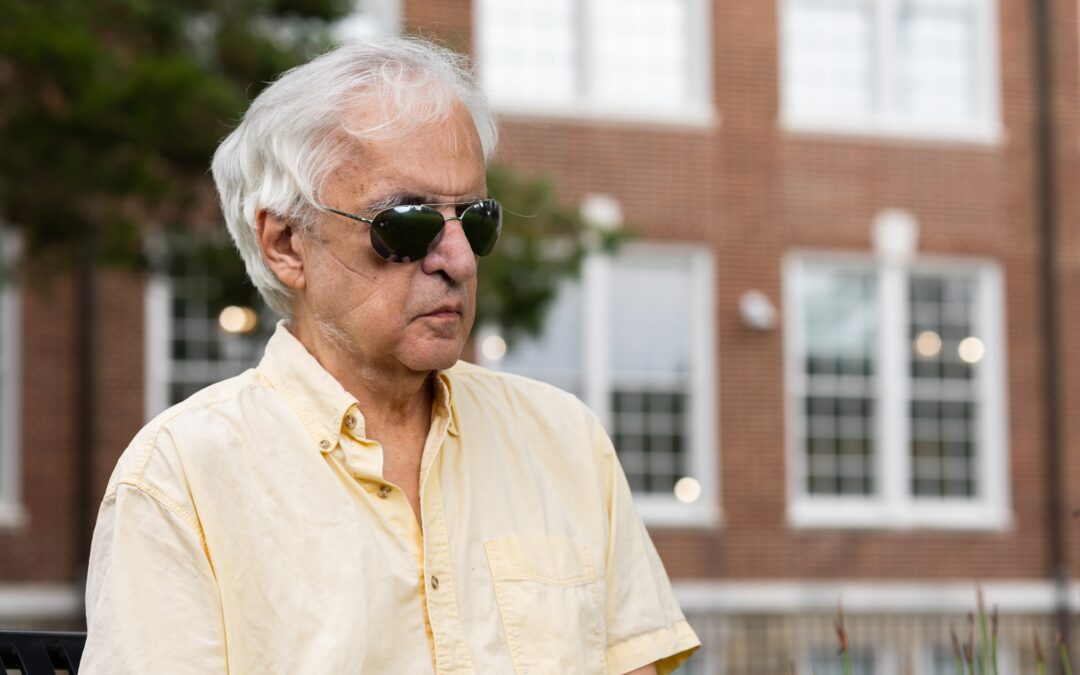
Hyperacusis Research is grateful for the generous gift of Anthony J. Sommo, Ph.D., who donated $42,000 after his death at age 75 to further our research to find a cure.
Tony was a sociology professor at Rowan University in Glassboro, NJ. He grew up in a working class New Jersey family and became blind at age 8, a few years after developing early-onset glaucoma.
Tony was a music-lover. Unfortunately, this love led to both tinnitus and hyperacusis, which he suffered from during his last 20 years.
Barry Carlson, the executor of his estate, noted how important it was to Tony that his gift be used for research.
Tony was educated at the University of Connecticut, always accompanied by his guide dog, Fern. He earned a bachelor’s degree, two master’s degrees (in psychology and social work), and a doctorate in sociology.
Later, he used a white cane, and had students as readers and assistants.
TINNITUS AFTER A LOUD CONCERT
Tony was social, street-smart and quick-witted. “If he was in the room, you knew it,” Barry said. He was a fan of movies, of baseball — favoring the Phillies — and of loud music.
Tony played the guitar, piano, accordion and saxophone. As a high-schooler, he had a band of his own, and sang the blues. His ear problems became apparent after a loud concert.
“For many of the years that I knew Anthony, I did not consider him to be handicapped,” Barry said. “I viewed him as a man who navigated the world in his own unique way, yet I must qualify this statement. I didn’t consider him to be handicapped until he contracted tinnitus at a concert. Tinnitus is a horrid disorder for a blind man.
Anthony’s world revolved around tone and sound, whether it was the tapping of his cane on the sidewalk or the voice of a play-by-play announcer on the radio. He told me that tinnitus was worse than blindness.”
His tinnitus appeared to be severe, while his hyperacusis was moderate. He could go to some restaurants and could listen to music, but not for long. As many patients do, he suffered from setbacks. He knew he had no choice but to live with his ear conditions — one reason he was so passionate about research.
“In time, Tony came to accommodate the background noise in his life,” Barry said. “Yet it was his wish to have tinnitus limited for others in the future.”
HIRED TO BE HIS EYES
Tony taught for 30 years at Rowan. Among his courses were “Deviant Behavior and Social Control” and “Sociology of Disability.”
“He was highly regarded and his classes were always in demand,” Barry said. He stopped teaching because of Covid. A blind man lecturing via Zoom — without being able to easily hear his students — didn’t work.
One student and assistant, Emily Casey, said that she was struggling when she arrived at Rowan. When she took a course from Tony, “I gained an advisor, a mentor, a job, and most importantly — a lifelong friend,” she said.
She is now a licensed social worker with a master’s degree, and “I know I have Professor Sommo to thank. I often think back and find it so ironic how I was technically hired to be his eyes, when in reality he was the one helping me see.”
HIDING FROM FIREWORKS
After Tony’s ear problems developed, he could no longer play musical instruments or attend concerts and loud gatherings. At one point, “he wanted so badly to avoid the sound of fireworks on July 4th that he spent the night in his office that had no windows,” said his colleague and friend Yuhui Li.
He moved to a house in a quiet neighborhood with a finished basement. “He loved everything about the new house, with the exception of just one not-so-minor problem,” she said. He couldn’t safely walk the few blocks from home to downtown, because part of the route lacked a sidewalk.
“For someone who had spent his whole life advocating for people with disabilities, this was an issue very close to home,” she said. “It is just another indicator that community infrastructure is often designed with inadequate attention to people with disabilities.”
Tony died at home, possibly from a heart attack.
After his death, friends, relatives and colleagues shared their thoughts and memories about Tony. People can read more about him here.
Hyperacusis Research is deeply grateful for Tony and all those who generously remember Hyperacusis Research in their estates. If you would like to name Hyperacusis Research as a beneficiary of your estate, one of our board members is an estate planning attorney and can help you with language in your will. Contact us here and we can assist.