
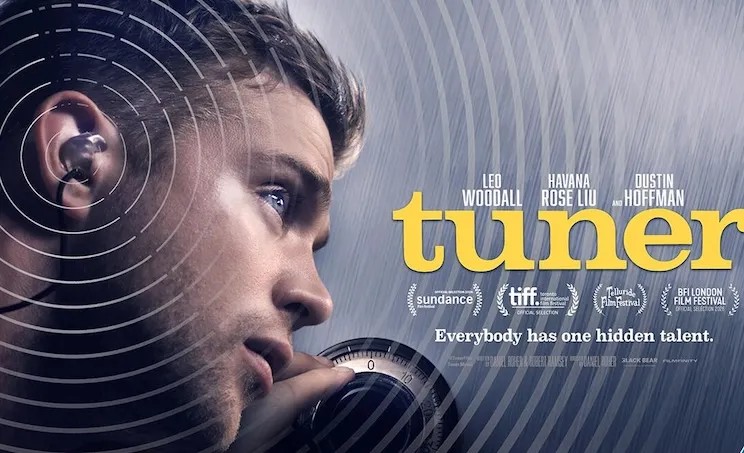
For the first time ever, hyperacusis takes the lead in a major motion picture, Tuner. The Washington Post has named Tuner one of the best movies of 2026. We agree! Tuner is an engaging crime caper with a love story on the side, and it sheds needed light on this truly awful, hidden condition.
Tuner stars Leo Woodall, who is as appealing as can be, and Dustin Hoffman, as delightful as ever. It’s not a documentary, and it does take some creative liberties, but it accomplishes something that we have long hoped for: Introducing millions of people to the word hyperacusis and portraying the condition with the empathy it deserves, rather than as a punchline or a freak show.
Niki, played by Woodall, is a former piano virtuoso, now a piano tuner, whose acute hearing allows him to crack safes. He likely acquired hyperacusis from overexposure to loud music. Similarly, it’s no surprise that his piano-tuning mentor, Harry, played by Hoffman, has hearing loss. So many musicians have hearing problems, whether that be hearing loss, tinnitus, hyperacusis, or a combination.
We learn that Niki has spent two years hiding from sound, trying to adapt to his condition, which amplifies ordinary noise to horrifically loud and painful levels.
He gets upset when his love interest, Ruthie, played by the gorgeous Havana Rose Liu, tells him he has no direction and no goals. In fact, he has spent years alone in quiet, helping him improve to his current level.
It’s hard to explain to people with normal hearing how incapacitating hyperacusis really is and how avoiding additional noise trauma is a top priority. Friends and relatives aren’t always sympathetic.
Niki has developed many of the coping strategies that patients rely on to navigate daily life.
His constant avoidance of sound, and his reliance on earplugs and earmuffs, are all behaviors common to patients struggling to avoid the pain of ordinary, everyday sound. Niki winces and recoils when the sound is too intense for him. Even doubling up on ear protection—earplugs plus earmuffs—is not always enough.
As those with hyperacusis know all too well, hearing protection is an absolute necessity—something that makes it possible to get through the day, and prevents setbacks and reinjury.
Niki also experiences tinnitus, which the film’s sound designer makes apparent when Niki is hit with an unavoidable loud noise or when his enemies use noise as a weapon.
Some people with tinnitus may have hyperacusis and—without the vocabulary to articulate their symptoms—may not know what it is. They may feel stabbing, burning ear pain from clinking dishes, barking dogs or revving engines, unaware that such sensitivity even has a name.
Niki has a mild-to-moderate case of hyperacusis and is able to function. In real life, of course, hyperacusis is by no means a superpower. It can be life-limiting in the extreme.
Hyperacusis exists on a vast spectrum of severity. For some, the condition is so disabling that they are unable to do much of anything or go much of anywhere. They cannot tolerate the sounds in almost every public place — stores, restaurants, offices or movie theaters. They may be able to watch Tuner at home via streaming, at very low volume with captions, or with no sound at all.
But they can send their doctors to the cinema to gain at least a modicum of understanding about hyperacusis, which is sorely lacking among the medical community. Tuner, with its intimations that point to the awful reality, is a great start.